

Carthage: How a Mediterranean Superpower Collapsed from Its Own Success By NewsSurvivor Editorial Desk
Carthage once ruled Mediterranean trade, commanded powerful fleets, and shaped ancient economies — yet it collapsed not because of Rome alone, but because its hunger for control, profit, and dominance slowly isolated it from the very world it depended on, proving that no empire falls only by invasion, but first by losing its balance between power and wisdom.
PHOENICIA
NewsSurvivor Editorial Desk
11/23/20251 min read
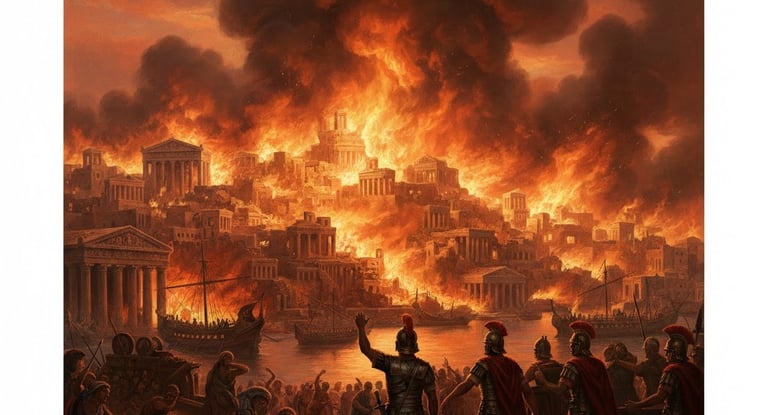
Carthage was once one of the most powerful and wealthy civilizations in the Mediterranean world. At its peak, it controlled major trade routes, dominated naval warfare, and influenced economies from North Africa to Southern Europe.
Yet Carthage did not fall simply because of Roman aggression.
It collapsed because it slowly destroyed itself.
When Trade Became an Obsession
Carthage’s strength was built on commerce.
Its ships connected continents, its markets supplied empires, and its influence stretched across seas.
But economic power slowly turned into something else: control.
Carthage began to dominate not only goods, but also access.
Trade routes became choke points.
Ports became pressure tools.
Allies became dependent customers.
Economic brilliance slowly transformed into economic arrogance.
The Cost of Control
Instead of building regional unity, Carthage focused on dominance.
Smaller city-states were taxed heavily.
Competitors were pushed out.
Agreements became one-sided.
Over time, Carthage stopped being a partner to the Mediterranean world and became a gatekeeper.
Resentment grew quietly — long before Rome ever arrived with its legions.
Internal Division Before External Invasion
Carthage also failed to unify its own Phoenician roots.
Rather than forming a unified cultural and political network with other Phoenician cities, it competed with them, financially and strategically.
Unity was replaced by rivalry.
Cooperation by control.
By the time Rome threatened Carthage militarily, the empire had already weakened itself through isolation.
Rome Was the Fire — Not the Spark
Rome did not invent Carthage’s collapse.
It only accelerated it.
By the time Carthage and Rome entered the final conflicts, many of Carthage’s former partners had little motivation to defend it. Some even welcomed its fall.
The destruction of Carthage was not only a military defeat.
It was the end of a system that had lost its balance between power and responsibility.
A Pattern That Repeats
Carthage’s story is not unique.
History repeatedly shows that civilizations collapse not at the peak of their weakness, but at the peak of their arrogance.
Empires rarely fall because they are poor.
They fall because they forget humility.
Editorial Reflection
Carthage leaves behind an uncomfortable lesson:
Economic power without moral wisdom does not build empires.
It builds expiration dates.
News Survivor © 2025. All rights reserved.
Disclaimer:
NewsSurvivor.com blends historical inspiration, spiritual reflection, and fictional storytelling to explore generational trauma and human healing. Some content includes poetry, symbolic narratives, and imaginative reconstruction of ancient civilizations. It is created to inspire thought, not to present academic or clinical conclusions. For medical, psychological, or historical expertise, consult qualified professionals.